
A Successful Tempo for Setting Two
It turned 40 this year. Based on its release date in Christian Worship, however, it’s only four years old for the vast majority of WELS congregations. How have you found it to be so far? For some who have just started, it may well feel like the one-year-old learning to walk, still finding its feet. Haven’t cracked it open yet? I don’t doubt that there’s a fair number of churches where it’s still in a pre-born state—Sunday morning worshipers haven’t ever seen it or heard it or sung it before. That would be true of the church where I currently serve.
“It” is Marty Haugen’s liturgical setting entitled, “Mass of Creation” (Christian Worship, Setting Two). Happy 40th birthday!
Haugen has, of course, written fairly prolifically in the realm of liturgical music and psalmody. Christian Worship: Service Builder also includes both his Morning and Evening Prayer settings. Some have debated whether Haugen’s settings have a longer or shorter shelf-life, but in broader circles than our own synod (and for a long time now) there has always been something about Setting Two. It’s like what they say about a song you like—if you haven’t yet found yourself getting tired of hearing it, it’s possible that there’s some good musical craft built into it. I’ve heard this setting for roughly twenty years and haven’t tired of it yet. I realize that, after brief or long term use, not all will feel that way.
I recall comments during the WELS Hymnal Project that described Mass of Creation (now Setting Two) as having a certain gravitas or seriousness to it. To some degree, such comments undoubtedly have to do with the fact that it is written in the key of G minor. That gravitas comes through in both of the main ways the setting can be played: organ (with brass and timpani, as available) or piano (with guitar/instruments/hand percussion, as available). Choral harmony parts are also available in the full arrangements on Musician’s Resource.
Best avoided (some would say “to be avoided like the plague”), however, is that which reflects the original Latin meaning of the term gravitas—heaviness, weightiness. Simply put, when played too slowly, Setting Two will feel oppressively heavy; it will drag and easily become dirge-like. The comment I have consistently heard from any musician who has seen this setting work well in their congregation runs along the lines of “it needs to be played at a pretty decent clip.”
A few samples are likely the easiest way to demonstrate that. (Bear in mind that most of the samples you will find via online search are based on the revised 2010 text; Christian Worship has the original, unrevised text.) The organ version of the Setting Two “Glory to God in the Highest” from Christian Worship: Service Builder Playlist can be heard here. The musically related “Holy, Holy, Holy” with a similar tempo is here. Appearing more dated (presented in black/white) than it actually is, a sample of the Gloria sung with the unrevised text is here. Note the tempo once more in this piano performance of the Gloria (yes, he’s playing without any music). Tempo is key for the “Gloria” and “Sanctus” of Setting Two. (The “Lamb of God” in Setting Two and countless other settings is regularly played more slowly to present a different mood.)
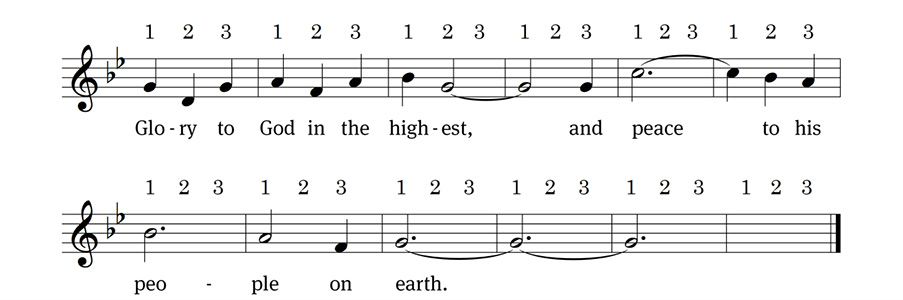
Musicians may use the phrase “feel it in one” when talking about the tempo of “Glory to God in the Highest” and “Holy, Holy, Holy” in Setting Two. It might be easier to simply use the term pulse. It could be illustrated this way:
If you think of giving an equal emphasis to each beat in every measure, you might picture a conductor moving his/her hand in the shape of a triangle for these canticles with a 3/4 meter, with the baton hitting each point of the triangle. If attempts were being made (especially on the part of the keyboardist) to give each beat its due, the song would sound very choppy and the tendency would be to slow it down. (Sing the lines below while slightly nodding your head up and down for every number and you’ll probably sense what I’m talking about.)
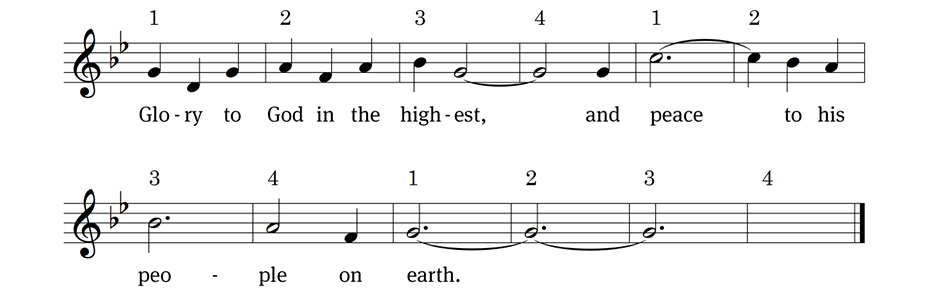
If you think instead of a single main pulse at the beginning of each measure, a conductor might appear to be conducting these two canticles rather slowly, as if they were written in 4/4, with the baton touching the four points of a cross, but there would be plenty of space between each pulse to allow the song to keep moving along “at a pretty decent clip.” (Sing the lines below while slightly nodding your head only at the numbers shown.)
The bottom line for a successful tempo for Setting Two would not be to say, “As fast as your keyboardist can play it,” since some keyboardists could leave the assembly in the dust. In some cases, based on the proficiency level of the keyboardist, as fast as it can be played might be just right. In other cases, based on that same proficiency, as fast as it can be played may be too slow. In any case, the best advice may be to say, “Put your best efforts toward making sure these two canticles don’t drag; do all you can to keep them moving.” And with plenty of opportunities to gradually learn the songs, be as charitable and patient as possible as you seek to bring the singing congregation along for the up tempo ride.
This article in Devote Yourself was contributed by the team that previously created and distributed Worship the Lord. View past worship-related articles at worship.welsrc.net/downloads-worship/worship-the-lord.
1 Directing a 3/4 piece in a slow 4/4 tempo is not a recommendation, nor will it always work, as evidenced by “Holy, Holy, Holy” in Setting Two. It is only to illustrate, in a limited way, the concept of pulse.
Devote Yourself
Volume 2, Number 9
September 2025
Tags: Worship
Michael Schultz
Rev. Michael Schultz has served WELS congregations in Flagstaff, Ariz., and Lawrenceville, Ga. He chaired the hymns committee for Christian Worship: Supplement and served as project director for the WELS Hymnal Project. He enjoys working on arrangements that combine piano and guitar. Michael currently serves as a parish pastor in Tallahassee, Fla., and is the chairman of the WELS Commission on Worship.
