
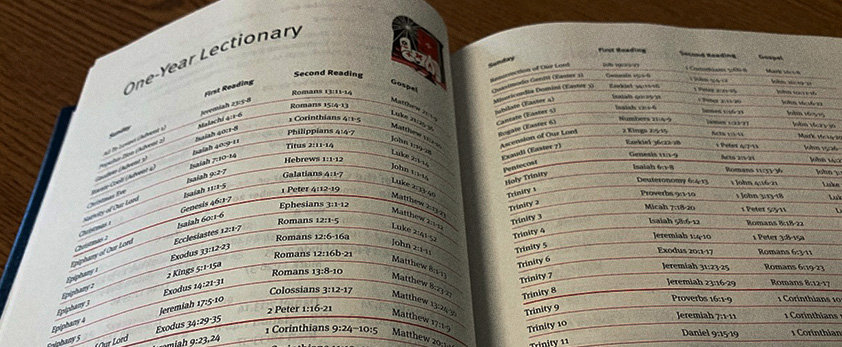
One Year Lectionary
I have come to the One-Year Lectionary as one abnormally born. Before trying it last year, the extent of my experience was in worship during my year studying at the seminary of our sister synod in Germany, the ELFK. I did not decide to try it because of some great conversion experience that led me to realize it is the one true lectionary. I blame the yearly encouragement of the rogue one-year pastor in our circuit (who consistently gave his tongue-in-cheek encouragement to come over to the dark side). Over the next four articles I will share some tools I have come to appreciate in my one-year preparation, tools that I believe will benefit preachers using either lectionary offered in Christian Worship.
Preaching the Whole Counsel of God through the Lectionary
Paul told the elders in Ephesus, “I did not hesitate to proclaim to you the whole counsel of God” (Acts 20:27). Those who explore different lectionaries or different preaching series often have this motivation at heart. They want to proclaim the whole counsel of God to their congregation.
Weekly Themes
One useful tool with the One-Year Lectionary is found in the ELS hymnal, the Evangelical Lutheran Hymnary. The Three-Year Lectionary, especially the updated one in CW21, makes a point to tie all the readings together thematically. As someone new to the One-Year Lectionary, sometimes the theme connecting the readings was not easy to find. When that happened, I could just flip open the Hymnary to that week and find a one-word theme.
In the Hymnary, the hymns are organized largely by the church year, including the non-festival half of the church year. At the bottom of the page, each hymn is labeled by Sunday and by the theme or teaching for that Sunday. For example, “A Mighty Fortress” is found in the section labeled “Lent 1” and “Temptation.” “All Depends on Our Possessing” is labeled “Trinity 15” and “Contentment.” This tool helped me find themes that tied together a particular Sunday, but more than that, it helped me plan out what teachings I was going to cover over the course of the year (and see which ones I’m missing).
Yearly Teaching
I remember appreciating listening to a brother’s sermon where he paused in the middle of the sermon and said, “Now’s a good time to review a teaching we call a person’s ‘Time of Grace.’” It wasn’t necessarily the main point of the text, but he wanted to make sure that at least once a year his people would review and apply that teaching to their lives. If you chart the teachings listed in the Hymnary with the One-Year Lectionary for 2026-2027, you find the following:
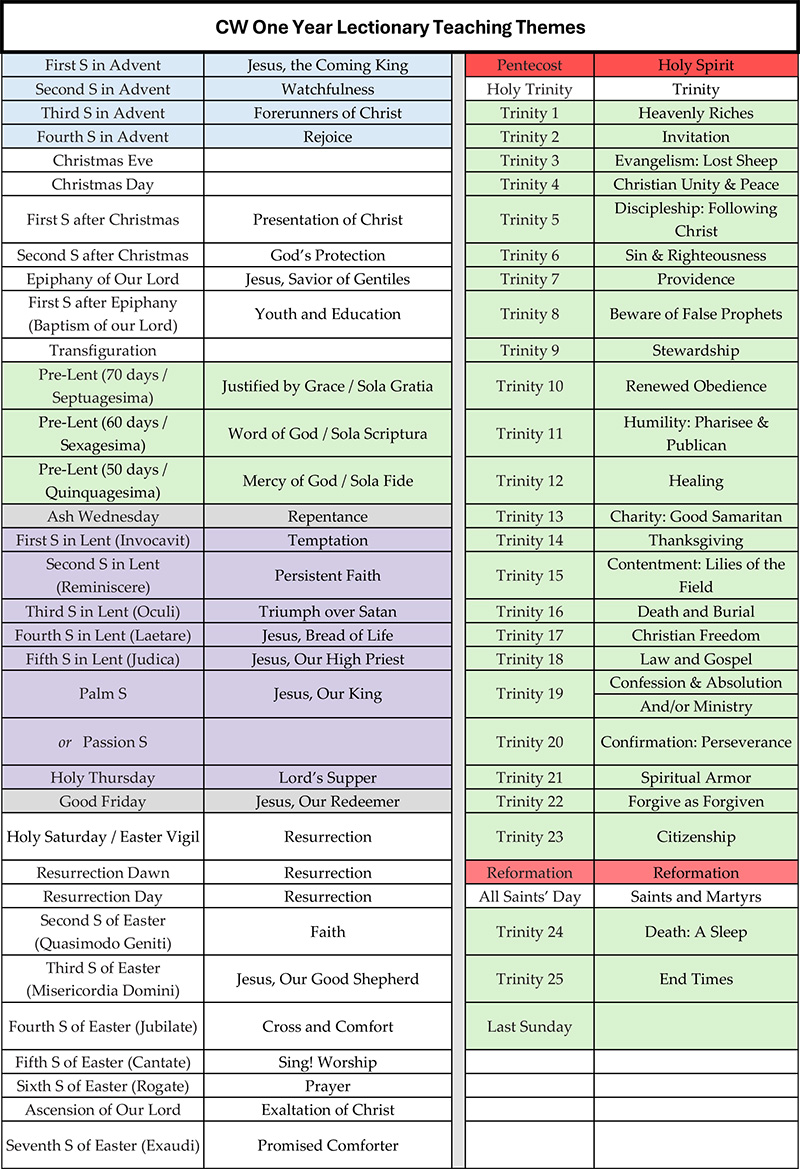
In the festival half of the church year, you find an appropriate emphasis on Jesus and his work. Besides Christmas and Easter, we have Sundays focusing on him as the Savior of the Gentiles, our Substitute (Presentation), our Bread of Life, our High Priest, our (Present) King, Coming, and Exalted King, our Redeemer, and our Good Shepherd. Even during the festival half of the church year, however, there are specific teachings.
The First Sunday after Epiphany is a yearly Education Sunday. When Easter isn’t so early, the next Sunday in Epiphany would be the Wedding in Cana, which can be your annual Marriage and Family Sunday. The three Sundays before Ash Wednesday help review the Solas of the Reformation (my congregation has enjoyed the repeated use of “Reformation Song” for these Sundays). Lent offers a chance to talk broadly about temptation (Lent 1), and also to talk specifically about demons and how to prevent them from moving in (Lent 3). You get to encourage both persistent faith (Lent 2) and faith (Easter 2) as opposed to doubt (doubting Thomas). In light of the resurrection, you can specifically talk about singing and worship in the Christian life (Easter 5) and review the teaching of prayer (Easter 6).
What other teachings are important to review with your congregation once a year? The non-festival half of the church year covers many of them, and some you may not have come up with off the top of your head.
- Stewardship Sunday is covered on Trinity 9, and tangentially on Trinity 1 (probably best to have two Sundays about that!).
- Trinity 2 (Invitation) makes a great annual Welcome Home Sunday, and the annual Evangelism Sunday is on Trinity 3 (I like the LCMS hymnal’s suggestion to add verses 11-32 of Luke 15).
- Thanksgiving is covered on Trinity 14 so you can have a good conscience if your congregation decides against a Thanksgiving service this year.
- Trinity 17 could be a good annual reminder of the principles of adiaphora with new applications every year (maybe artificial intelligence finds an application here). If mastering law and gospel is the highest art, then an annual review on Trinity 18 seems helpful. Could Trinity 16 (Death and Burial) help me remember to hand out funeral planning documents annually or have a related Bible study that day?
- Finally, I see Trinity 6 as the “catchall” Sunday because it has the Ten Commandments. Which commandment seems most urgent to review? This Sunday happens to fall on July 4 in 2027. It could work well to narrow the focus to the Fourth Commandment. An LCMS pastor expands the reading from the Sermon on the Mount to include Jesus’ teaching on whatever commandment he’s focusing on that year (lust is covered just after the Gospel reading). This could be a good service to annually read all Ten Commandments and their explanations from the small catechism in the hymnal.
Preaching Choices
Preaching the carefully curated One- or Three-Year Lectionaries ideally frees you of the burden of worrying too much whether you have preached the whole counsel of God. At the same time, charting out which doctrines you are covering can help you decide which text to preach on and which “tangents” are worth the word count. For example, I notice that next year’s One-Year schedule does not have a specific Sunday on Baptism (having no Baptism of Jesus in the One-Year is one of things I miss the most). I may make a point to preach the Romans 6 reading on Trinity 6 or 7 and review the basics of Baptism. Since the season of Epiphany isn’t long enough to include Marriage and Family Sunday in 2027, I may be quicker to make use of the Mother’s Day or Father’s Day readings suggested in CW on the appropriate weekends.
Try charting out the list of teachings from the Hymnary with your worship planning next year. Or find appropriate Sundays to make sure you are covering the truths of the Small Catechism every year. You could also review the non-festival hymn categories on page 299 in CW and see if you are covering the categories listed there. Whatever you do, do not hesitate to proclaim to your congregation the whole counsel of God.
Appendix: Example of Three-Year Lectionary with potential teachings to touch on/review
Devote Yourself
Volume 3, Number 6
June 2026
Tags: Preach
Julius Buelow
Rev. Julius Buelow is a 2018 graduate of Wisconsin Lutheran Seminary who has served at St. Paul in Saginaw, Michigan and Mt. Olive in Lincoln, Nebraska. He is married and has four children.
