
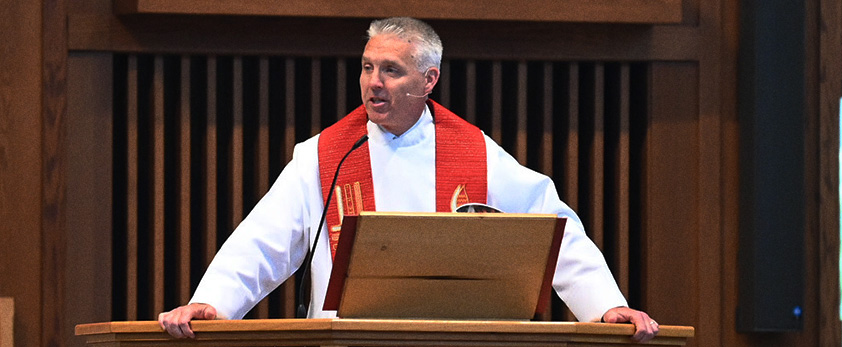
Where do you stand when you preach?
Where do you stand when you preach?
By “where do you stand,” I’m not asking what your stance is on a particular issue that you might talk about in a sermon. I mean the question literally: when you preach, do you stand in a pulpit? Behind an ambo? In the middle of the chancel? In one place, or do you move around?
I’ll reveal here at the outset that I am not going to issue a ruling on the correct place to stand when you preach. What I would like to do is examine some reasons why preachers stand in one place and not another when they preach.
This is not a scientific study of the issue. I’m basing what I say on my own observations and on conversations I’ve had with preachers. My goal is to get preachers thinking a little more deeply about this, and perhaps to prompt an informal conversation or two, especially between preachers who stand in different places for different reasons.
That said, here are four factors that seem to affect why some preachers choose to stand in a pulpit or behind an ambo, while others stand in the center of the chancel or move about when they preach. I’ll call the four factors preferential, practical, communicative, and symbolic. Note that for many preachers, there’s not a single reason why they stand where they do; two or more of these four factors mix and mingle with each other. Nevertheless, separating them might help us examine each one.
Preferential. This one is self-explanatory. We all have our personal preferences and comfort zones. Some preachers like to have their Bible and notes in front of them, so standing behind an ambo makes sense. Other preachers prefer to hold their Bible and move around; it’s just what feels comfortable for them. Some preachers feel more comfortable and confident in one place versus the other.
Practical. Practical factors sometimes play a role. For example, a church has a camera that they use to livestream their services. The camera is stationary and mounted high on the back wall. The picture for viewers is better when the camera can be zoomed in on the center of the chancel. Therefore, that’s where the pastor stands when he preaches. Sound and amplification factors may be important. While most churches use wireless microphones, not all do. A stationary mic in the pulpit requires the preacher to stand there. Sound factors, by the way, caused historic churches to construct tall pulpits with a Schalldeckel, a canopy covering. The Schalldeckel was more than just decorative; it enabled the preacher’s voice to resonate throughout the church in pre-amplification days. Some churches may have balconies, and the pulpit is the place to stand so that those in the balcony can see. In any case, practical factors may inform where the preacher stands.
Communicative. Some may move away from an ambo or out of a pulpit because they see where they stand as affecting how they communicate. A preacher who often preaches scriptural narratives, for instance, tries to bring the biblical stories to life in the minds of his listeners. One of the ways he does this is to stand in one place when he’s paraphrasing the words of one biblical character, then move a few steps and turn his body when relating the words of another character. Another communicative factor may be one related to a sermon manuscript. One preacher writes carefully and at times consults his manuscript to say things in a precise way. He may want his notes on the ambo in front of him. A different preacher, however, wants to preach freely and not look at a manuscript. So, he deliberately moves to the center of the chancel in order to force himself to preach without notes. Communicative factors may be the main ones in play.
Symbolic. These are the factors, in my experience, that bring about the most impassioned discussion and disagreement. Some preachers stand where they do because their choice signifies something much bigger. A few examples…
For some preachers, standing in a pulpit or behind an ambo signals trust in the power of the preached word. For them, the presence of a pulpit or ambo is more than merely functional; these furnishings silently symbolize the truth that God chooses to save and to work in human hearts “through the foolishness of what was preached” (1 Cor 1:21). They preach from a pulpit not only because of personal preference but to make a statement about the power of gospel proclamation. Related to this, some wish to signal the importance of the public ministry of the gospel: while all are priests, only some are called by Christ through his church to preach on behalf of the body. Standing in pulpit signals that.
For other preachers, walking around while they preach sends what they believe are more important signals. As one example, some see walking around as they preach as communicating a willingness to get closer to their hearers. They realize that some listeners come into the church carrying a perception that Christian preachers want to claim authority over them without even knowing them. Think of the negative connotation of words like “preachy” and “sermon” in many people’s minds, or of expressions like “six feet above contradiction.” Conscious of this, some preachers don’t stand in a pulpit or behind an ambo to prevent being perceived, especially by worship guests, as authoritarian or out of touch. Another message some may intend to send: “I realize that standing in a pulpit is traditional, but I’m not bound by tradition. Instead, I am willing to sacrifice customs and traditions for the sake of communicating the gospel.”
Differences may surface when one pastor is preaches at a neighboring congregation where the pastor typically preaches in a place the guest preacher is not used to. He has to choose: “Should I preach where I usually do and send the signal I want to send, or stand where the pastor usually does in this church and communicate something I don’t want to?” Anthropologists like Webb Keane might call this a clash of “semiotic ideologies”: different groups attach different importance to certain signs and actions. Some interpersonal friction occurs when we meet or work with someone who attaches different significance to the same sign, like where a preacher stands when he preaches.
One final factor I might add is novelty. Is where the preacher stands most noticeable when he makes a change? Those who used to preach from the pulpit but no longer do probably received a number of comments when they made that change. People noticed! They might have commented on how they stayed more attentive during the sermon. Something I have wondered about is whether that effect lasts. Do listeners who make such comments feel the same way a year after the change as they did the first Sunday after the change? Perhaps they do. Or perhaps they don’t notice after a while. What have you observed?
Where do you stand? If I may offer a suggestion, next time you are discussing or debating this, ask some questions: “What does where you stand signify to you? What do you think it signifies to your listeners?” I’m interested to learn your experiences and thoughts. If you wish to share, e-mail me at [email protected].
Devote Yourself
Volume 3, Number 5
May 2026
Tags: Preach
Jon Micheel
Prof. Micheel teaches preaching and church history at Wisconsin Lutheran Seminary, where he has served since 2020. Previously he served congregations in California and Utah. He is one of the moderators for the Preacher Podcast, produced in conjunction with The Foundation worship resources from WELS Congregational Services. He was the chairman of the rites (liturgy) committee for the WELS Hymnal Project and contributed chapters to Christian Worship: Foundations. He is currently a doctoral candidate at Concordia Seminary (St. Louis) in homiletics.
