
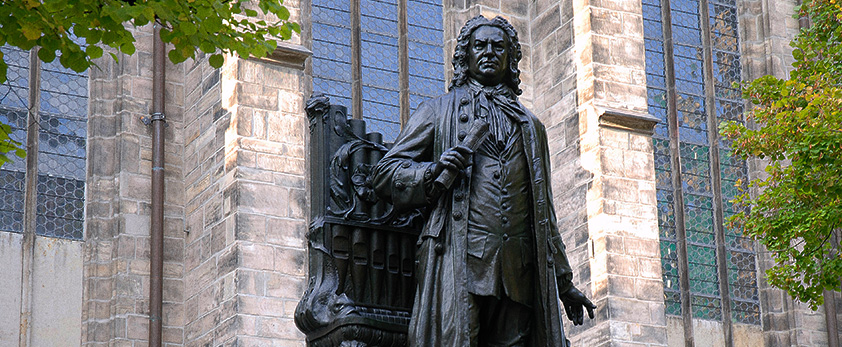
Bach Cantatas as a Preaching Tool with the One-Year Lectionary
J.S. Bach’s Faith
In the library of Concordia Seminary, St Louis, is a three-volume Bible once owned by J. S. Bach (1685-1750). These volumes not only include Luther’s translation of the Bible with extensive commentary by the orthodox dogmatician Abraham Calov, but they also include handwritten notes by J. S. Bach himself. Bach, arguably the greatest Lutheran composer of all time, was not Lutheran in name only. One of his notes is found next to 2 Chronicles 5:13, where all the trumpeters, musicians, and singers give thanks to the Lord, for “he is good; his love endures forever.” Beside this verse, the composer sometimes called the fifth evangelist writes, “NB. Where there is devotional music, God is always present with his grace.”
Devotional Music for the One-Year Lectionary
Bach wrote many cantatas as devotional works centered on the appointed readings for Sunday worship services. A cantata is a musical style invented by Lutherans, alternating congregational hymns and chorales with reflective poetry by various soloists. Even the way the music is composed is devotional, apart from the extensive use of Scripture from various texts to help interpret the Scripture for the day (search “Bach text painting” for a fun rabbit trail). Because Bach composed at least one work for every Sunday in the historic church year, he provides a wealth of devotional music that can at the very least help the pastor apply the texts for the upcoming Sunday to himself, and at best can help him prepare a sermon that drives home the theme of that Sunday into the heart of his hearers. Bach’s work for the 27th Sunday after Trinity (labeled Bach-Werke-Verzeichnis 140, or BWV 140) serves to illustrate how this can happen.
BWV 140 and Devotional Sermon Preparation
The pastor reads the gospel for Proper 27 (Year A) or Last Sunday (One-Year), the parable of the wise and foolish virgins (Matthew 25:1-13). He then opens up the text of the corresponding cantata (interlinear English and German) on bach-cantatas.com. He finds that Bach bases his cantata on the Lutheran “King of Chorales,” “Wake, Awake, for Night is Flying,” by the Lutheran pastor Philipp Nicolai (1556-1608), which also happens to be the hymn of the day appointed by CW.
Movement One: “Wake, Awake,” Stanza One
The work begins with the first verse of the hymn, with the watchman calling the wise virgins to meet the approaching Bridegroom (Song of Songs 3:3; Isa 52:8). The music itself is stately, like a royal procession, with the soaring sopranos waking the city mit hellem Munde (CW: “the thrilling cry”). The pastor senses by the tone of the music that this is no ordinary wedding and no ordinary bridegroom. This is a parable about the kingdom of heaven—and this bridegroom is the King (25:1). What an honor that he (the pastor) and his congregants are invited to this wedding banquet!
The clear shout of the sopranos point him to Matthew 25:6. The messenger isn’t mentioned in the text, just the clear and joyful message. The pastor reminds himself that he doesn’t really matter; only his message. He wants to proclaim loud and clear whether in season or out of season, whether at midday or midnight: “Come out to meet him!” He will remind his people that while the world is dark and ignorant of Christ’s imminent return, the gospel call is still going out loud and clear.
Movement Two
Next the tenor solo connects the gospel text to Song of Songs. The virgins become the daughters of Zion awaiting the King (Songs of Songs 3:11). They see him bounding over the mountains like a deer (2:8) to bring the feast to the mother’s house (3:4). The pastor remembers the joy of his children seeing a deer leaping in a field. He thinks of the anticipation of the arrival of the wedding party so that the meal can begin. Maybe this is the Sunday where he actually quotes Song of Songs in a sermon!
Movement Three
The voice of the longing soul of the believer (the soprano) converses with Jesus (always a bass soloist). The believer asks, “When are you coming?” Jesus answers, “I’m coming, your portion” (Psalm 73:26). The believer responds, “I wait with burning oil!”
The pastor examines his own soul’s longing for Christ and confesses his own sleepiness. He asks God to keep his oil full and lamp burning through the means of grace. He will lead his people to confess their own spiritual drowsiness and shares with them the gospel that the Lord has come, waking them and forgiving their failure to watch and pray as they should. It’s not too late! Through the gospel, Jesus still invites them now: “Come, lovely soul!” Come, be filled with my promises and become wise through faith in me!
Movement Four: “Wake, Awake,” Stanza 2
The chorale becomes the believer’s faith-filled response. The pastor is ready! His heart leaps for joy to trust that the bridegroom is his friend from heaven, strong in grace and truth, leading him to the hall of joy. He notes that the closing line of the German is “Und halten mit das Abendmahl,” and sees that the “Supper” is capitalized in the hymnal for a reason. Nicolai and Bach, like all Lutherans, found in “das Abendmahl” a foretaste of the heavenly banquet. The pastor will tell his congregation that when they next march up to communion, they are following the heavenly bridegroom to the hall of joy and can therefore be confident that they will not be shut outside in the dark on the Last Day.
Movement Five
The bass (Jesus) sings again. He says to the pastor and to all believers that he chose them and betrothed himself to them from eternity. He has placed them like a seal upon his heart and arm (Song of Songs 8:6ff). His loving embrace (2:6/8:3) is stronger than death and will lead them to forget the trouble and sorrow of this life. The pastor thinks wedding illustrations are appropriate for the sermon, and plans to talk about all the worry and the planning that goes into a wedding, and how it all is forgotten when the couple says, “I will.” He plans to console his congregation, promising that the worry and sorrow of this text and this life will all be forgotten when the one who has betrothed himself to them from eternity will embrace them with his everlasting love. His sermon will prove to them that Jesus’ love is stronger than death by proclaiming his death on the cross and the nail wounds that sealed us on his arms.
Movement Six
Once again, the soul responds to Jesus’ promises with conversation, taken from the Song of Songs (2:16-17), inviting the hearer to the same devotional response. The soul and Jesus singing the final line together remind the pastor and congregation that the greatest joy of heaven is being with Jesus, and singing Jesus’ resurrection song together with him: “There will be fullness of joy; there will be delight.” (See Psalm 16:11.)
Movement Seven, “Wake, Awake,” Stanza 3
The stately procession reaches its destination as all the heavens, saints, and angels join to sing. The pastor notes that the parable ends without describing what happens on the other side of that door. Nicolai’s chorale correctly says, “No vision ever brought, no ear has ever caught such great glory.” Yet the slowing music and the praise of this stanza remind the pastor that God has given us a way to prepare for the unknown. Maybe he will conclude his sermon by telling his people to be like a driver who asks the person riding shotgun to strike up a conversation with him so he can stay awake. The virgins were not alone; neither are we. We can strive to stay awake together—watchful, ready, and eager for the joys of heaven—by “conversing” with our Savior, praising him together until that final call comes.
Conclusion
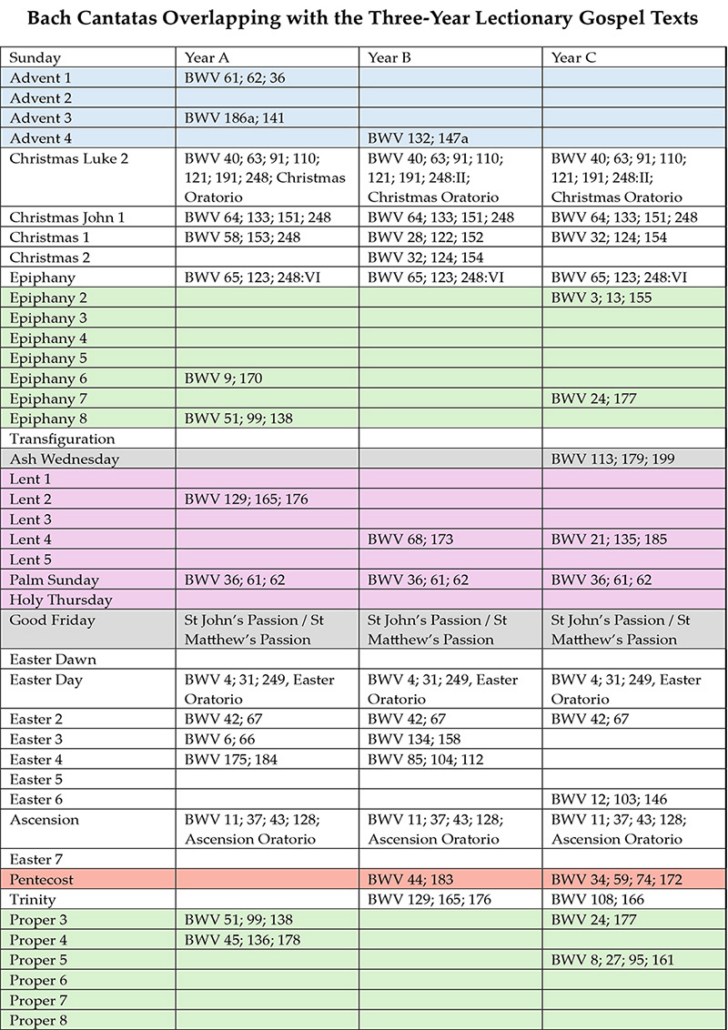
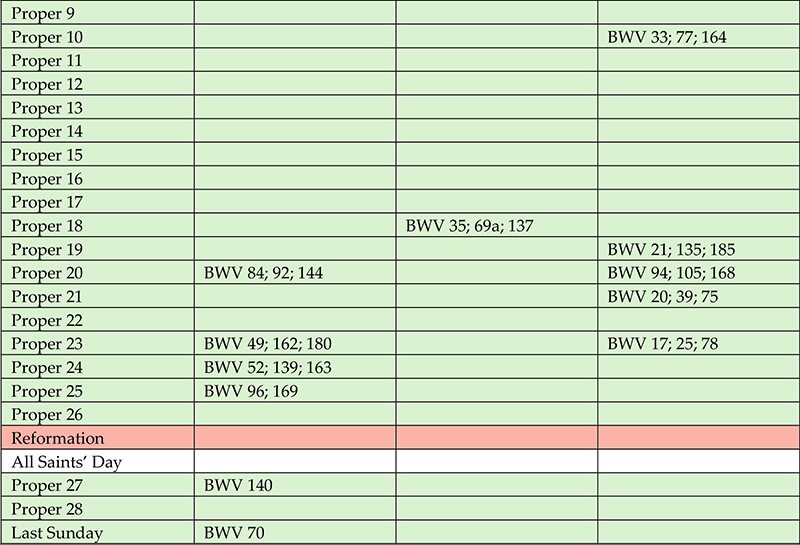
While the three-year lectionary does not line up as consistently with Bach’s works, there is still plenty of overlap. Matching the cantatas to the Sunday with a corresponding gospel reading yields at least a dozen opportunities a year for the preacher to try a different or additional method of sermon preparation. Anyone adept with a search engine or AI tool will find countless high-quality recordings, translations, summaries, and cantata themes that could enhance both his preaching and his appreciation for our Lutheran heritage in song. Whatever lectionary you use, I hope the fifth evangelist is still able to preach to your heart and to your congregation.
Additional Resources
- This book from the WLS library demonstrates how the cantatas fit into the three-year lectionary.
Setterlund, John. Bach Through the Year: The Church Music of Johann Sebastian Bach and the Revised Common Lectionary (Minneapolis: Lutheran University Press, 2013).
- Bach Cantatas Overlapping with the Three-Year Lectionary Gospel Texts
Devote Yourself
Volume 3, Number 8
August 2026
Tags: Preach
Julius Buelow
Rev. Julius Buelow is a 2018 graduate of Wisconsin Lutheran Seminary who has served at St. Paul in Saginaw, Michigan and Mt. Olive in Lincoln, Nebraska. He is married and has four children.
