
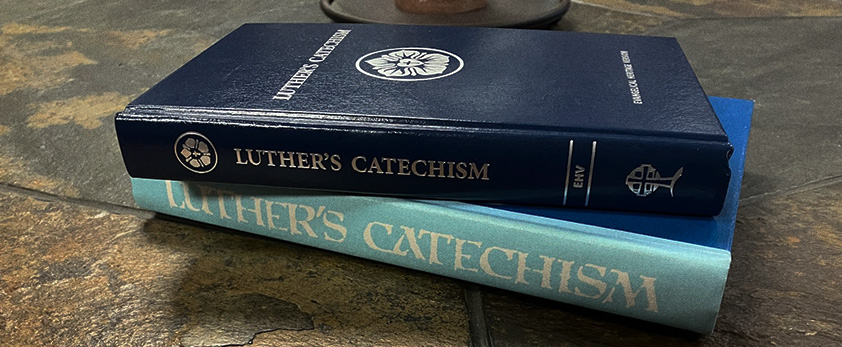
Using Luther’s Small Catechism
One year early in my ministry I had seven students of confirmation age, and I realized that all of them came from families in which the mother was a member and the father was not. I knew the statistics about membership retention if the father was not active in church. I also knew that some of the students would have a difficult time making it to all the classes because of the indifference of the father.
I told the families I would save them many trips to church. I would teach confirmation instruction at their home, but only if the father was willing to sit in. With the help of their wives, all seven fathers agreed. I found a schedule that allowed me to teach seven confirmation classes at seven homes on a Saturday. I was away from the parsonage for at least ten hours on those days.
At each home we sat around the table. At the end of the first class, I handed the catechism I was using to the father and said, “Keep that as your own copy. We just went through these questions. You can ask them to your child during the week. Here are the correct answers they are to give from memory.” I did not show them the famous “as the head of the family should teach them in the simplest way to those in his household” until a few weeks later.
Every father played along the second week. Eventually two of the fathers dropped out, both, as I recall, because they felt guilty about something in the Ten Commandments but were unwilling to repent. Five fathers stuck with it. They began a semblance of a family home altar. They were confirmed with their children. One of those fathers was baptized and confirmed on that special confirmation day. His son is now a WELS pastor.
I understand that many of the brothers have developed ways to teach the Small Catechism that engage today’s middle school students. Will those methods work in individual homes? Will parents or guardians learn something from both the content and your instructional methods?
Luther told the story of developing his Small Catechism as a remedy after visiting new Lutheran congregations and discovering that people were lazy when it came to Word and sacrament. When we survey the condition of our congregations and realize that people are lazy when it comes to Word and sacrament, my advice is that we return to teaching the content of the Small Catechism. For children it is a valuable textbook. For teenagers and adults who have no children it is a valuable devotional book. Parents and grandparents have to figure out the best ways to review it. If you are unfamiliar with the mechanics of using the Small Catechism yourself in a devotional way, so that you can teach it, you can find a vivid description of how to do that in Martin Luther’s A Simple Way to Pray: For Master Peter, the Barber.
Because you teach it regularly and have developed the places you deal with modern questions and concerns, you know that Luther’s Small Catechism is genius. It has stood the test of time. Can anyone summarize Law better than Luther in the Ten Commandments? Can anyone tie them together better than he does with his “we should fear and love God”? Who explains the nature of our big and promising God better than Luther in the First Article explanation? Who does Christ—not as example, but Christus pro nobis—better than the Second Article? And who ties it all to Christ’s resurrection better? Who shoots down the vast majority of American Protestant teaching better and more succinctly than “cannot by my thinking or choosing believe in Jesus Christ my Lord, or come to him”? Who does the Christian life better than Luther in the Lord’s Prayer? And who does the Sacraments as gospel better and more succinctly? Table of Duties (vocation)? We have a reason for asking in the rite of confirmation about Lutheran teaching “as summarized in Luther’s Small Catechism.”
The loss of a certain percentage of students to active participation in the life of the congregation after confirmation should not lead us to give up on the Small Catechism as instructional material. In fact, I propose that it should lead us to double-down on training children to use it after confirmation. Maybe we have to improve format and methods of delivery. In a large church, using the method I describe above might require a full-time person. If I understand Lutheran history correctly, such a staff minister has been called to service at different times and in different places and was called a catechist.
Devote Yourself
Volume 3, Number 3
March 2026
Tags: Teach
Paul Prange
Rev. Prange serves as the director of WELS Commission on Worship. His broad ministry experience includes time as a home missionary, a world missionary, administrator for Ministerial Education, and a parish pastor, but most people remember him as president of Michigan Lutheran Seminary, 1994–2009. He was chairman of the committee that prepared the Psalter as part of the new WELS hymnal suite.
